Feng Shui and Your BTO: What to Look for Before You Ballot
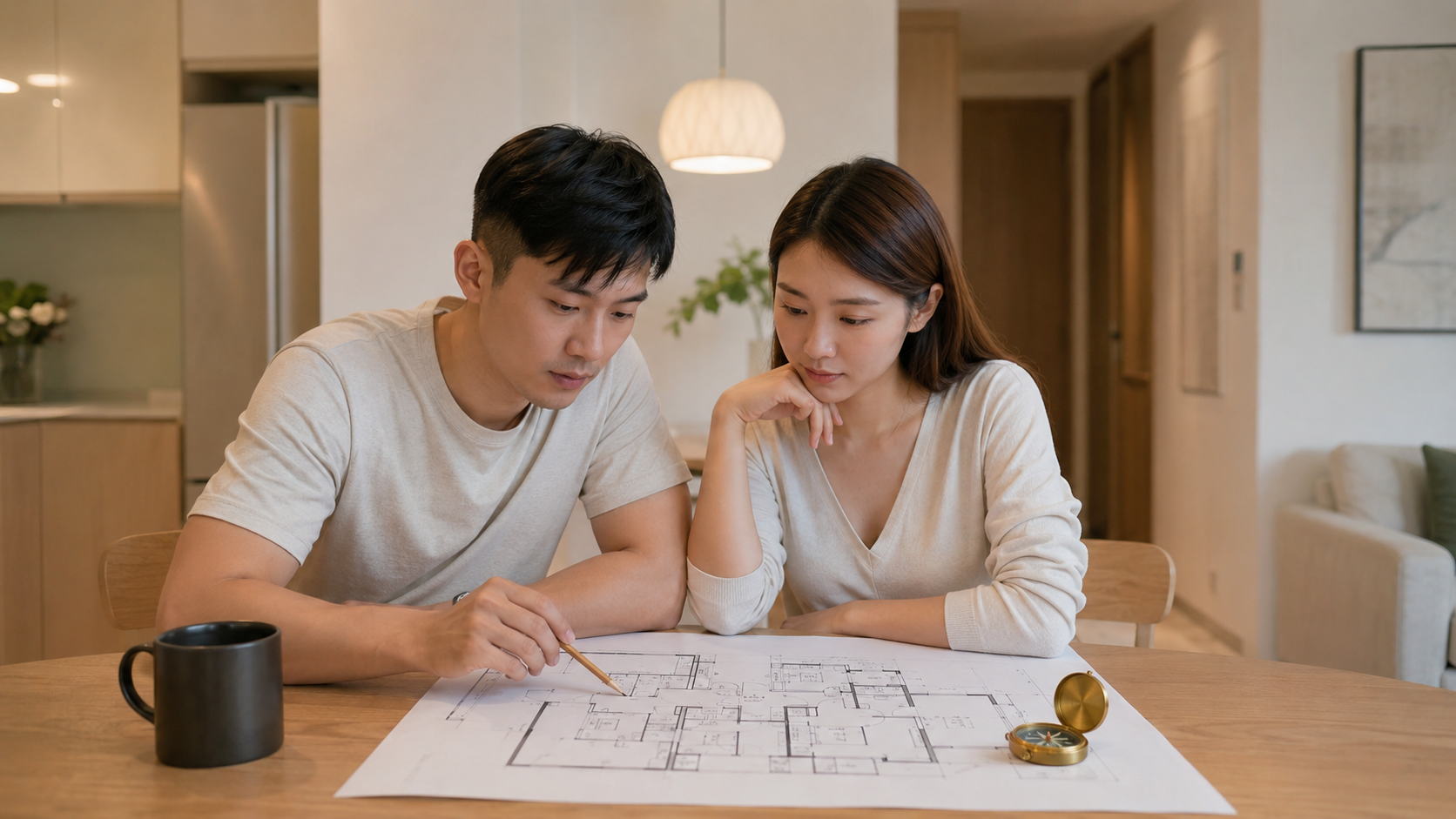
You've been refreshing the HDB website. The new BTO launch is up, and the site plan is finally live. You've checked the map for nearby amenities, cross-referenced the MRT distance, and debated the merits of a corner unit versus a mid-stack flat.
But there's one more layer of due diligence that many Singaporean buyers — particularly those buying their first home — are quietly starting to factor in: feng shui.
This isn't about superstition. It's about understanding the environmental and spatial factors that influence how energy flows through a home — and making an informed decision before you commit to something you'll live in for the next 20 to 30 years.
Here's what to look at before you ballot.
Why BTO Buyers Are Thinking About Feng Shui
The renewed interest in feng shui among younger Singaporean buyers isn't a trend driven by their parents alone. It's practical reasoning.
A BTO flat, unlike a resale unit, comes with almost no interior history to evaluate. You're selecting a unit based on a floor plan, a site map, and a stack number. That's it. What you're really doing is choosing an orientation, a position within a block, and a relationship to the surrounding environment — all of which are exactly what classical feng shui assesses.
The difference between two units in the same development can be significant. One stack may face a broad green corridor and receive clean morning light. Another may be directly opposite a T-junction road or back onto a large electrical substation. These aren't aesthetic preferences — they're structural factors that affect the quality of your living environment, and feng shui has a systematic framework for evaluating them.
More importantly, the BTO ballot is a one-shot opportunity. Unlike a resale purchase where you can walk through multiple units over several weeks, BTO buyers are selecting from a site plan during a launch window. Getting your assessment right the first time matters.
Facing Direction: The Most Important Variable
If you could only evaluate one thing before balloting, make it the facing direction of your unit.
In feng shui, the facing direction — the direction your main door or primary window faces outward — determines how and what type of qi (energy) enters the home. This is the foundation of most classical systems, including Flying Stars (Xuan Kong Fei Xing) and Eight Mansions (Ba Zhai), both of which are commonly used in residential assessments.
What to check on the site plan:
Identify which direction your unit's main door faces. On HDB site plans, north is typically indicated — use this to map your unit's orientation.
Note what is directly in front of the facing direction at a distance of roughly 20 to 100 metres. Open space, a park, or a broad road is generally favourable. A dead-end road pointing at your block (a T-junction or Y-junction), a large rubbish collection point, or an overhead structure directly opposite is not.
If your flat faces another HDB block at very close range — sometimes as little as 15 to 20 metres away in denser developments — consider whether that creates a long, narrow "sha qi" corridor between the blocks, particularly if wind tunnels through.
A note on personal facing direction: In Eight Mansions feng shui, your favourable directions are determined by your Kua number, which is derived from your birth year and gender. Ideally, your main door faces one of your four auspicious directions. This is worth calculating before you ballot — not after.
Unit Number and Floor Level — Does It Matter?
This is the question almost every first-time buyer asks, and the honest answer is: it depends on the system you're using, and how much weight you choose to give it.
Unit numbers carry significance in both feng shui numerology and the more widely practised Chinese cultural belief around lucky and unlucky numbers. The number 4 (四, sì) sounds like the word for death in Mandarin and is widely considered inauspicious. Numbers containing 8 (八, bā) are broadly favoured for their phonetic association with prosperity. Combinations like 48 are sometimes avoided; 88 or 168 are often sought after.
In practice, most classical feng shui consultants will tell you that the unit number is a minor factor compared to facing direction, internal layout, and environmental landform. It is, however, something to be aware of — particularly if you intend to sell the property in future, since buyer perception of unit numbers does affect resale demand in the Singapore market.
Floor level has more structural relevance. Higher floors generally enjoy better airflow, clearer sightlines, and less ground-level sha qi from roads, drains, or heavy foot traffic. However, very high floors in some classical systems are considered overly "yang" and lacking grounding energy, which can affect sleep, stability, and health.
As a general rule:
Floors 3 to 6 are often considered well-grounded without being too exposed.
Mid-range floors (7 to 15) tend to offer a balance of elevation and stability.
Very high floors (above 20) can be energetically active — suitable for some occupants, less so for others depending on their personal profile.
The "best" floor is not universal. It depends on who is living there.
Stack Selection: What to Look for on the Site Plan
The stack — your unit's vertical column within the block — is one of the most overlooked variables in BTO selection and one of the most important in feng shui assessment.
Avoid stacks that are directly aligned with:
Lift lobbies at the end of a long corridor. A door that faces directly down a long internal corridor (a "poison arrow") accelerates qi through the space too quickly, creating instability in the home.
Staircases. Units immediately adjacent to or opposite a stairwell are exposed to constant movement energy, which can be unsettling over time.
Rubbish chutes. This is both a practical and feng shui consideration — odour, pests, and negative qi from waste accumulation are all relevant.
Corner units deserve special mention. They are popular for their privacy and larger floor areas, but they also have more exterior walls, which can mean more exposure to external sha qi from multiple directions. Assess them carefully — a corner unit with a strong facing direction and good environmental surroundings can be excellent; one that faces a T-junction from two angles is more complicated to remedy.
End stacks in some blocks face an empty void or open sky on one side. This can be favourable if the open side corresponds to your unit's facing or a secondary auspicious direction — or unfavourable if it exposes the home to harsh afternoon west sun and the associated "fire" energy without adequate balance.
Cross-ventilation is a related, practical point. HDB BTO flats typically achieve cross-ventilation through north-south or east-west unit orientation. Good cross-ventilation aligns with feng shui principles around qi circulation — stagnant air and stagnant energy are treated similarly in both frameworks.
When to Consult a Feng Shui Expert Before Balloting
Most people think about feng shui after they've collected the keys. By that point, some issues can be remedied through interior design — placement of furniture, the use of symbolic enhancements, or structural adjustments within the permitted HDB renovation guidelines. But some cannot be changed at all.
The facing direction of your main door cannot be moved. The stack you're in is permanent. The environmental surroundings of your development are fixed.
These are the factors that a pre-ballot feng shui consultation addresses — before you commit.
A pre-purchase BTO Feng Shui Review typically covers:
Analysis of the site plan, block orientation, and facing directions of shortlisted stacks
Assessment of the surrounding landform — roads, waterways, neighbouring structures, open spaces
Identification of any external sha qi sources
Evaluation of individual stacks against the occupants' personal ba zi (birth data) or Kua numbers
A clear recommendation on which stack and floor range to prioritise, and which to avoid
This kind of review is most useful when done during the launch window — before balloting closes — so you have time to make an informed selection rather than a reactive one.
It's also worth noting that feng shui assessments at this stage are considerably more cost-effective than renovation-stage remedies. Repositioning your entire master bedroom because the facing direction is wrong is expensive. Choosing the right stack in the first place is not.
Make the Most of Your Ballot
The BTO process gives you limited time and limited information. What you do have is the site plan, the stack list, your shortlist of units — and, if you use it, a structured framework for evaluating what you're actually choosing between.
Feng shui doesn't guarantee outcomes. What it does is give you a rigorous, time-tested lens for assessing spatial and environmental quality in a way that goes beyond square footage and floor finish.
If you're balloting in the upcoming HDB launch and want a professional assessment of your shortlisted stacks before you submit your application, we can help.
Balloting soon? Ask us about a pre-purchase BTO Feng Shui Review.