How to Feng Shui Your HDB Living Room Without Buying a Single Trinket
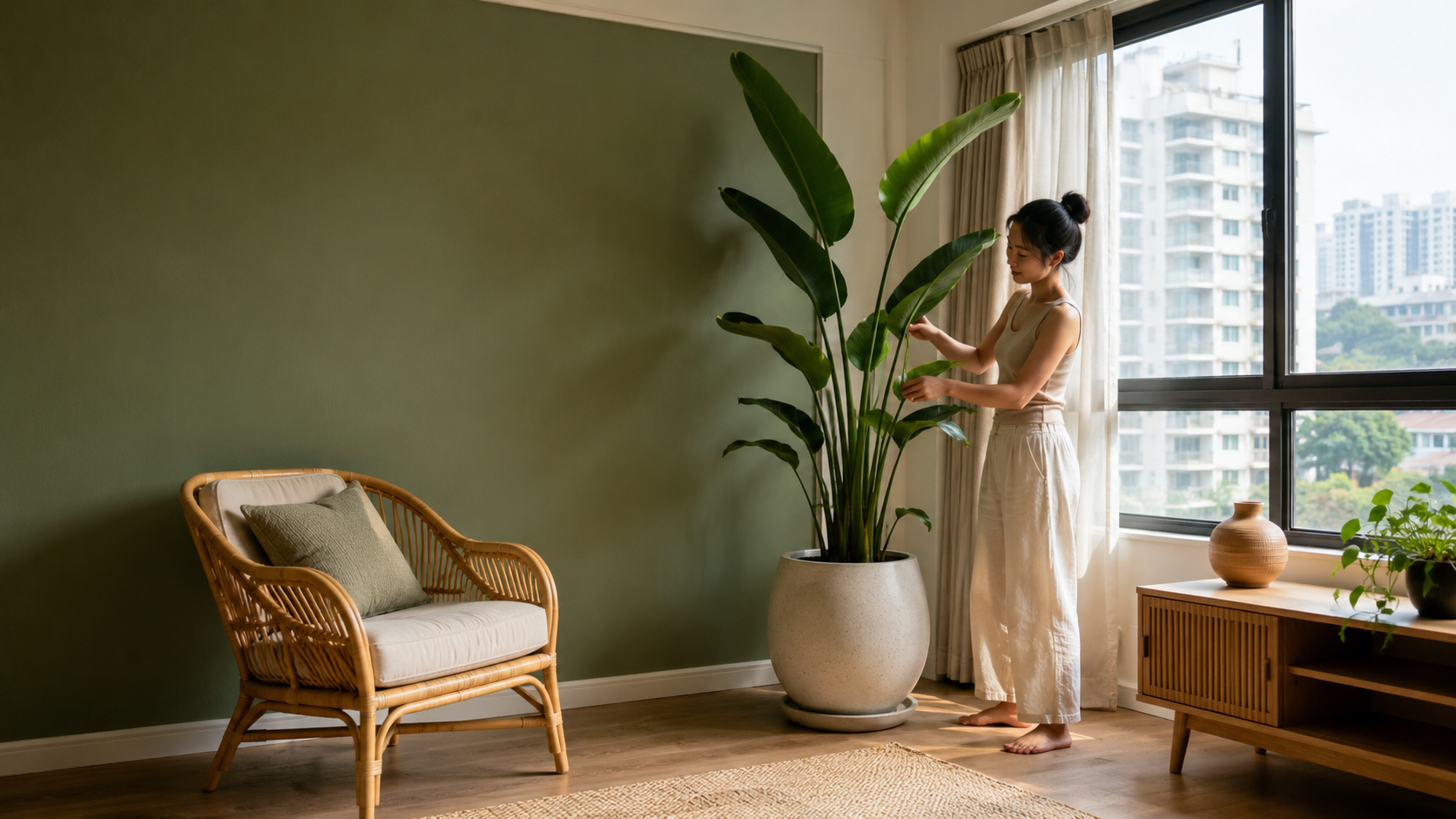
Walk into a well-arranged HDB living room and you feel it immediately — a quietness, a sense of ease, like the room is working with you rather than against you. That's not coincidence. That's qi flowing freely.
Here's what most people get wrong about feng shui: they think it requires a trip to a Chinese medicine hall and a shelf full of figurines. It doesn't. The most powerful feng shui adjustments in a living room cost nothing at all. They're about where your sofa sits, how light enters the space, and whether the room allows energy — and people — to move through it with ease.
If you live in an HDB flat, you already know the constraints. Standard layouts, shared walls, windows that face wherever the block was oriented. The good news? Feng shui was always meant for real homes, not showrooms. Here's how to work with what you have.
The #1 Rule: Clear the Path for Qi
Before you touch a single piece of furniture, walk from your front door to your sofa. Count how many times you have to sidestep, shuffle, or squeeze past something. Each obstacle is a place where qi — the life force that feng shui seeks to harmonise — gets snagged, slowed, or blocked.
In a typical HDB living room, the most common culprits are:
Shoe racks that jut into the entryway. If your rack sits at an angle or protrudes more than 30cm from the wall, it creates a pinch point at the very place qi is meant to enter your home.
Coffee tables that are too large for the sofa. A coffee table should allow at least 45cm of clearance on all walkable sides. If you're turning sideways to reach the TV console, the table is too big.
Cables and cords trailing across the floor. Beyond being a hazard, loose cables symbolise tangled, stagnant energy. Tuck them away or use cable ties — a five-minute fix with a real feng shui return.
The principle here is simple: qi moves like a gentle breeze. It shouldn't rush (too few furnishings, too much open space at speed) and it shouldn't stall (too cluttered, too many right-angle blockages). A living room that's easy to move through is already halfway there.
Sofa Placement: The Command Position Explained
The command position is one of feng shui's most practical and immediately impactful concepts. Applied to your sofa, it means this: the person seated should have a clear sightline to the main door without being directly in line with it, and should have a solid wall — not a window or open space — behind them.
In an HDB flat, this often looks like placing the sofa along the wall perpendicular or diagonal to the main entrance, so that anyone sitting down can see who enters the room without being the first thing the door "hits."
Why does this matter? Beyond symbolism, there's a deeply practical reason. When your back is to an opening — a door, a large window, an archway — your nervous system registers low-level vulnerability. You can't fully relax. Seats with solid backing consistently feel more comfortable and grounding, which is why the best restaurant banquette or the senior partner's chair almost always faces the room.
What to avoid in a Singapore context:
Sofa directly facing the main door. Qi rushes in and hits the occupants directly — energetically "confrontational."
Sofa pushed against a window wall. Glass doesn't provide the same psychological solidity as a structural wall, especially on higher floors where wind pressure is noticeable.
Sofa backed up to the kitchen pass-through or open shelving. These create visual and energetic restlessness behind seated occupants.
If your current layout doesn't allow for a true command position, a tall indoor plant or a low bookshelf placed behind the sofa can act as a symbolic "mountain" — providing that sense of support.
Mirrors — Where They Help and Where They Don't
Mirrors are one of feng shui's most misunderstood tools. In the living room, they can genuinely improve how a space feels — but placement matters enormously, and bigger is not always better.
Where mirrors work well:
Reflecting natural light deeper into the room. If your HDB unit has a window on one side only (common in point blocks), a mirror on the adjacent wall bounces light further in, making the space feel brighter and more expansive. Position it so it catches and redirects the window light — not so it faces the window directly, which can create a sense of energy "bouncing back out."
Along a short wall in a narrow living room. Many HDB living rooms are longer than they are wide. A full-height or wide mirror on the shorter end wall creates the illusion of width without any structural change.
Behind a plant or beside a dining area. Reflecting something beautiful — a healthy plant, a well-laid table — symbolically "doubles" abundance in the space.
Where mirrors cause problems:
Directly facing the main door. This is the most common feng shui mirror mistake. A mirror that faces the front door is said to push incoming qi — and good fortune — back out before it can settle.
Above the sofa. Practically, a heavy mirror above where people sit creates subconscious unease. Energetically, it places an active, reflective surface overhead — unsettling rather than grounding.
Facing the TV when it's off. A dark TV screen already acts as a partial mirror. Two reflective surfaces facing each other create a visual and energetic loop that can feel restless.
One well-placed mirror is worth more than three poorly positioned ones. Choose intentionally.
Plants That Work Hard in a Living Room
In feng shui, living plants are among the most effective tools available — not because of superstition, but because they literally improve the environment. They filter air, add humidity, introduce organic shapes that soften hard architectural lines, and bring the wood element into a room that often skews toward metal (air-conditioning units, TV frames, glass).
For an HDB living room, the most useful plants are those that thrive in indirect light and tolerate air-conditioning — two realities of Singapore apartment living.
High-performers for feng shui and practical reasons:
Monstera deliciosa — Large, glossy leaves that move gently in air-conditioned airflow. Symbolises growth. Tolerates lower light well.
Pothos (money plant) — Trailing or climbing, easy to maintain, one of the best air filters available. Placing one near the TV console softens the tech-heavy corner.
Peace lily — Thrives in low light, flowers occasionally, and actively filters airborne toxins. Works well near windows that don't get direct afternoon sun.
ZZ plant — Near-indestructible, with upright growth that symbolises upward momentum. Good for corners where other plants struggle.
Placement logic: In feng shui terms, the southeast corner of the living room is associated with the wood element and wealth energy. A healthy, well-tended plant positioned here does double duty — visually anchoring the corner and reinforcing the elemental energy of the space. If your southeast corner is occupied by a wall or structural column, the area beside your main window is always a good second choice.
One important note: plants must be healthy to be beneficial. A dying, wilting, or neglected plant introduces the opposite of the intended energy. If a plant is struggling in a particular spot, move it — don't keep it there out of habit.
Lighting as a Feng Shui Tool
Most HDB living rooms come fitted with a central ceiling light. It works, but it's the feng shui equivalent of eating only one type of food — technically sufficient, energetically flat.
Feng shui favours layered lighting because it allows the room's energy to shift with the time of day and the mood required. In practice, this means:
Natural light first. This is non-negotiable. If your living room has curtains that are habitually closed, open them. Morning light in particular is activating — it signals the start of the day's energy cycle. If privacy is a concern (as it often is for lower-floor HDB units), sheer curtains allow light while maintaining screening.
Supplement with warm-toned task and accent lighting. Harsh cool-white LEDs create the feeling of a fluorescent office — not a home. Swap your living room bulbs to warm white (2700–3000K range) and add a floor lamp or table lamp in a darker corner. Light that comes from multiple heights — not just overhead — makes a room feel alive and inhabited rather than surveilled.
Address dark corners deliberately. In feng shui, stagnant dark corners collect dead energy. A small upward-facing lamp, a well-lit plant, or even a candle placed consistently in a dark corner keeps that area energetically active.
The TV screen at night. This one surprises people: a very bright TV in an otherwise dark room creates a strong yin-yang imbalance — all the energy in one focused point, darkness everywhere else. Keep at least one other light source on in the room while watching TV. It's better for your eyes and better for the room's energy balance.
Putting It Together: A Living Room That Breathes
You don't need to action all of this at once. Start with one change — clear the path from your door to your sofa — and notice how the room feels. Then try repositioning the sofa if you can. Add a plant to the southeast corner. Swap a bulb.
Feng shui in an HDB flat isn't about perfection. It's about removing friction — the visual, physical, and energetic friction that accumulates in a space over time and quietly drains the people living in it. A room that breathes well supports the life being lived inside it.
If you'd like help mapping your specific unit layout to feng shui principles, room by room — get a personalised audit. Enquire about our Home Consultation.