Feng Shui for Your Home Office: Desk Placement That Actually Improves Focus
Working from home has become a fixture of Singapore life — from the freelancer in a Bishan condo to the SME owner running operations from a spare bedroom in Tampines. And yet, most of us set up our desks wherever they fit, not wherever they work.
Here's the thing: according to a widely cited workplace study, nine in ten workers believe that a well-designed workspace directly improves their performance and focus. Feng shui has been saying something similar for centuries.
This isn't about hanging crystals or memorising Chinese numerology. Feng shui office principles for Singapore homes are surprisingly practical — they overlap in meaningful ways with ergonomics, spatial psychology, and just good sense about how light and airflow affect the way we think. Read on to learn how a few deliberate adjustments to your home office setup can make your workday feel noticeably different.
Why Your Desk Position Matters More Than You Think
Before you dismiss desk placement as superstition, consider what poor placement actually costs you.
A desk shoved against a wall means you spend hours staring at a surface less than a metre away — straining your eyes and subtly reinforcing a sense of confinement. A desk with your back to the door means you're subconsciously alert to anyone entering behind you, which fragments concentration more than most people realise. A desk in a hallway or next to a high-traffic zone means constant visual and auditory interruption.
Feng shui addresses all of these. The tradition holds that our physical environment directly influences our qi — the flow of energy that governs vitality, clarity, and productivity. When that flow is blocked, stagnant, or erratic, so is our output.
Whether you frame it as energy or environmental psychology, the practical result is the same: your desk position shapes your mental state throughout the working day.
The Command Position: Sit With Your Back Supported
The single most important feng shui principle for your home office is this: sit in the command position.
This means placing your desk so that you face the room's entrance — the door or the main opening — without being directly in line with it. Your back should be against a solid wall, not a window, a corridor, or open space.
Why does this matter? In feng shui, having your back exposed leaves you energetically vulnerable. In practical terms, it creates a low-level anxiety that makes it harder to enter a flow state. The command position gives you a sense of control over your environment — you can see what's coming, literally and figuratively.
In Singapore homes, this can take some creativity. If your study room or bedroom-office corner doesn't allow for a full command position, try these workarounds:
Place a mirror so you can see the doorway reflected while you work — this partially restores the psychological sense of awareness.
Sit with your back to a half-wall or shelving unit rather than leaving it fully open.
Face the longest diagonal of the room, which often gives you the broadest sightline in compact HDB or condo layouts.
Best Directions to Face While Working
Once your command position is established, the next layer is your facing direction — a concept rooted in the Ba Gua (eight trigrams) and your personal Kua number.
Your Kua number is calculated from your birth year and gender, and it gives you four favourable directions and four unfavourable ones. For productivity and career growth specifically, the direction known as Sheng Qi (your personal success direction) is what you want to face while working.
If you haven't calculated your Kua number, a few general feng shui guidelines apply to most setups:
Facing north is classically associated with career and life path — a solid default for work desks.
Facing east supports growth, ambition, and new beginnings — well-suited if you're building something new.
Avoid facing south for intense focus work; south is associated with recognition and social energy, which can make concentration harder.
Avoid facing the wall directly at close range regardless of direction — distance matters as much as compass bearing.
In practice, Singapore's landed homes tend to have more flexibility here. Condo units, especially those with fixed room orientations, may require you to prioritise command position over ideal direction — in which case, command position wins.
Five Elements in a Home Office — Keeping Them Balanced
Feng shui organises everything — materials, colours, shapes, seasons — into five elements: Wood, Fire, Earth, Metal, and Water. A balanced workspace draws on all five in proportion, without any one element dominating.
Here's how to apply this in a Singapore home office without it feeling like a themed concept store:
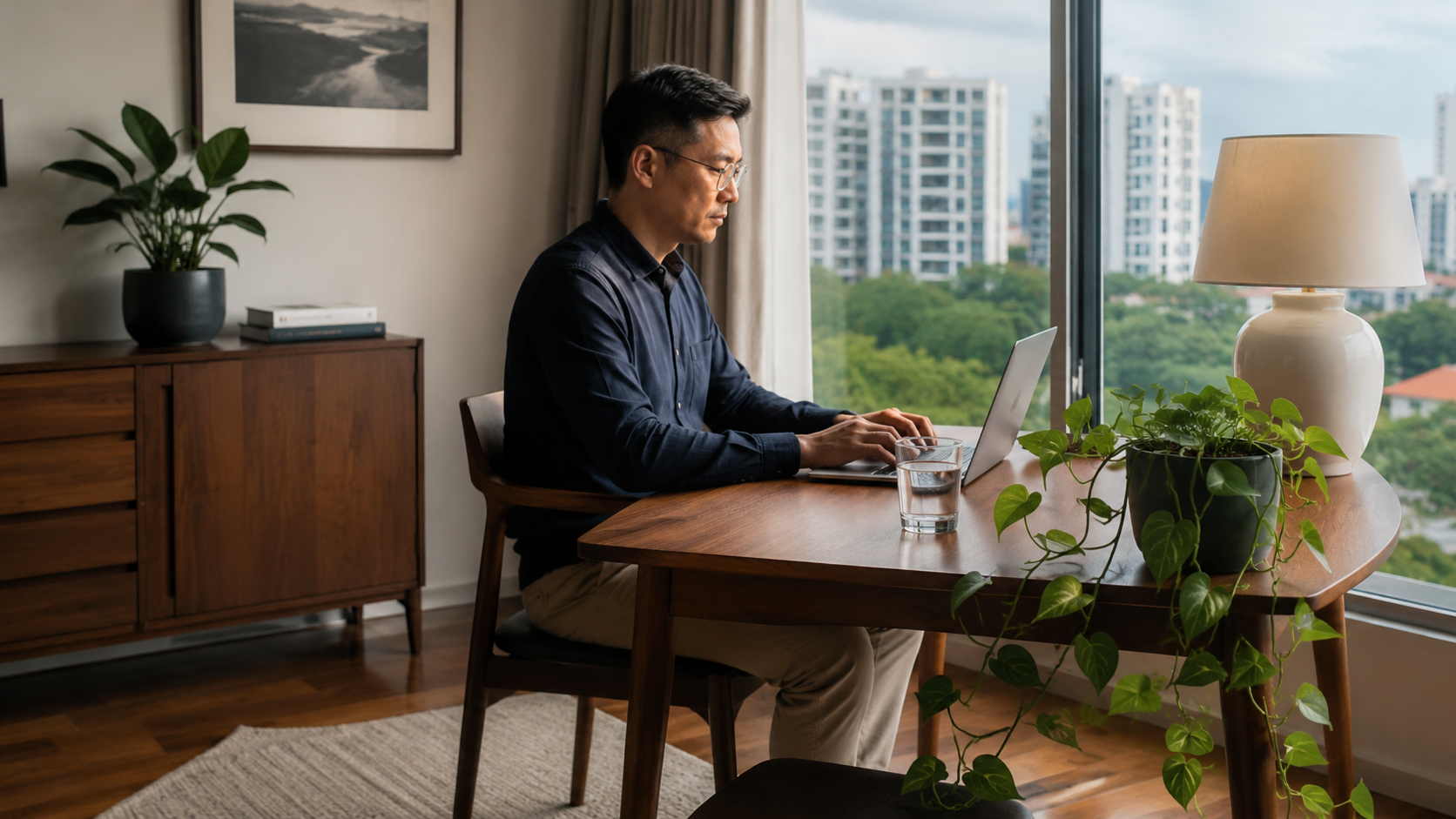
Wood — Growth, creativity, new ideas Introduce wood through your actual desk material (solid wood is ideal over laminate), a bookshelf, or a small plant. The trailing pothos is a favourite for home offices: low-maintenance, air-purifying, and considered an activator of growth energy.
Fire — Recognition, motivation, visibility A lamp on your desk introduces the fire element functionally and energetically. Opt for warm-toned light rather than harsh cool white. Avoid placing the lamp directly overhead — position it to the upper left of your desk (the wealth corner in feng shui).
Earth — Stability, grounding, concentration Earth comes through in ceramics, stone, and square or rectangular shapes. A small ceramic pen holder, a stone paperweight, or even a sandy-toned desk mat introduces earth energy without looking deliberate.
Metal — Clarity, precision, focus This is the element of the mind. Metal frames, a stainless steel water bottle, a white or grey colour scheme — all of these support clear thinking. Metal is particularly useful in roles that require analysis or decision-making.
Water — Flow, communication, opportunity A small glass of water on your desk is enough. If you'd like something more intentional, a mini tabletop water feature positioned to the left of your desk activates water energy without requiring much space.
You don't need all five present in large quantities — the goal is balance, not accumulation.
Plants, Water, and Light: Small Changes, Big Energy Shift
Three elements tend to make the most immediate difference in a home office, and they're all achievable within a weekend.
Plants In feng shui, living plants represent growth and vitality — and keep energy from becoming stagnant. For Singapore's humidity and condo light conditions, the best choices are pothos, snake plants (sansevieria), and peace lilies. Place them to the left of your desk or near a natural light source. Avoid cactus or thorny plants in your workspace — they introduce a spiked, agitated energy that doesn't support focus.
Natural light Ideally, natural light should enter from the side — left or right — rather than directly behind or in front of you. Light behind you creates glare on your screen; light in front creates eyestrain. Side lighting offers the most balanced, least tiring environment. If your desk faces a window, use a sheer curtain to diffuse the direct light without blocking the brightness.
In feng shui terms, natural light activates yang energy — the active, outward-moving quality you need during working hours. A dim, artificially lit workspace suppresses it.
Airflow This one is often overlooked. Stagnant air creates stagnant qi. In Singapore's sealed condo units, even cracking a window for part of the morning makes a measurable difference in alertness. If that's not possible, a small desk fan aimed away from you (to circulate, not direct) can substitute.
Putting It Together
A feng shui-aligned home office in Singapore doesn't require a renovation. In most cases, it requires a desk repositioned, a lamp added, a plant placed, and a mirror considered. Start with the command position — that single change tends to produce the most immediate shift in how the space feels to work in.
From there, work through the elements methodically. You'll likely find that the space starts to feel more intentional and, over time, more productive.
Ready to go deeper? A home office audit looks at your desk orientation, element balance, facing direction based on your Kua number, and any sha qi (disruptive energy) in your layout. Master Khoo works with SME owners and home-based businesses across Singapore. Book a consultation →